Mohali:
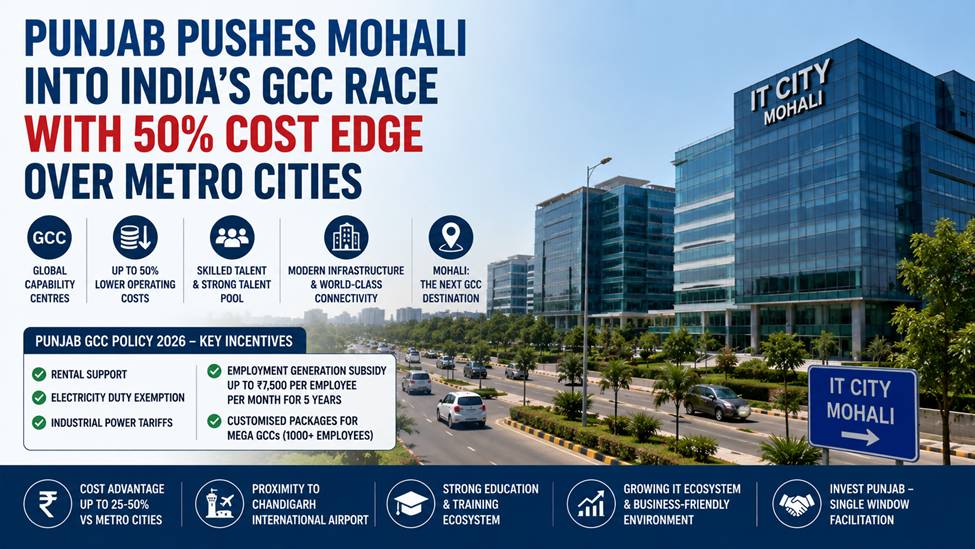
Punjab is stepping up its efforts to position Mohali as one of India’s next major destinations for Global Capability Centres (GCCs), with the state highlighting the city’s lower operating costs, skilled workforce, connectivity and growing technology ecosystem as key advantages over established metropolitan hubs.
The push comes as companies increasingly look beyond traditional IT centres such as Bengaluru, Hyderabad, Pune, Chennai and Gurugram for their next phase of expansion. Industry research suggests that Tier-II cities can offer operating-cost savings of around 25% to 50% compared with Tier-I metropolitan locations, largely because of differences in real estate, talent and other operating expenses.
Mohali is now being presented as one of the cities that can combine this cost advantage with the infrastructure and talent normally associated with larger technology centres.
Punjab Industries and Commerce Minister Aman Arora recently led an investment outreach in Bengaluru aimed at attracting global companies to the state. The delegation engaged with companies and industry organisations working across GCCs, IT and IT-enabled services, research and development and emerging technology sectors.
The state’s pitch is centred on what officials describe as a “Tier-I capability at Tier-II cost” proposition. The objective is to offer companies access to skilled professionals and modern infrastructure without the significantly higher operating expenses associated with India’s largest technology hubs.
Mohali already has an established technology base, with IT companies, educational institutions and professional services firms operating across the wider Tricity region. The city is also benefiting from the expansion of its commercial and technology infrastructure.
According to the Punjab Government’s GCC Policy 2026, eligible GCC units can receive a range of incentives. These include rental support, electricity-duty exemptions, industrial power tariffs and employment-generation subsidies. The first three mega GCC units employing more than 1,000 people may also be considered for customised incentive packages.
For eligible GCCs, the policy provides an employment-generation subsidy of ₹7,500 per employee per month for five years, subject to the applicable conditions. Rental support is also available for qualifying units with a minimum of 100 seats.
The state’s broader IT policy framework is intended to make it easier for companies to establish operations in Punjab. The government is also promoting Invest Punjab as a single-window mechanism to support investors with approvals and other requirements.
Cost, however, is only one part of the pitch. Punjab is also highlighting Mohali’s talent pool. The wider Tricity has a large base of engineering, technology and management professionals, supported by universities, engineering colleges, ITIs and other educational institutions.
The city’s proximity to Chandigarh International Airport is another advantage. Companies setting up GCC operations typically require frequent domestic and international connectivity for employees, executives and clients, making access to an airport an important consideration.
Mohali’s planned urban infrastructure is also being promoted as an advantage. Wide roads, established commercial areas and the availability of new development zones provide companies with options for expanding their operations as demand grows.
The quality-of-life factor is increasingly becoming important in the GCC market as well. Companies are looking for locations that can attract and retain skilled employees, particularly as technology roles become more specialised and competition for talent increases.
Mohali’s position within the Tricity gives it access to Chandigarh’s established education, healthcare and urban infrastructure while maintaining a lower-cost operating environment than many larger metropolitan markets.
The state is also trying to move beyond the conventional IT-services model. Artificial intelligence, data analytics, research and development, semiconductor-related activities and other emerging technology areas are increasingly part of Punjab’s investment strategy.
For Mohali, the GCC opportunity could have a wider economic impact. New centres would create demand for skilled professionals while also generating business for office developers, facility-management companies, technology suppliers, hospitality providers and other supporting services.
The arrival of larger GCC operations could also strengthen the city’s startup ecosystem. Employees with experience in global technology companies can contribute to entrepreneurship, while established companies can create opportunities for local startups and service providers to become part of their supply chains.
Punjab’s challenge now is to convert its investment pitch into actual commitments. Competition among Indian cities for GCC investments is becoming stronger, with several Tier-II locations offering their own combinations of incentives, talent and infrastructure.
Mohali therefore has to compete not only on cost but also on the quality and availability of talent, office infrastructure, connectivity, ease of doing business and long-term scalability.
The state’s latest outreach suggests that Punjab wants Mohali to be part of India’s next wave of GCC expansion rather than remain primarily a regional IT centre.
If the government’s policy incentives and industry outreach succeed in attracting large technology and GCC investments, Mohali could gradually develop a more diversified technology ecosystem, with global companies, startups, research centres and skilled professionals operating alongside one another.
The broader GCC trend is already moving beyond India’s traditional technology metros. For Punjab, that shift creates an opportunity to present Mohali as a location where companies can access skilled talent and modern infrastructure while potentially reducing operating costs significantly. With the state actively pursuing global investors and offering a dedicated policy framework, Mohali is now being positioned as a serious contender in India’s expanding GCC landscape.

Mohali Dialogues
I work as a journalist and digital content writer for Mohali Dialogues, specializing in local news, civic issues, government updates, politics, education, business, and technology. I am committed to creating factual, well-researched, and engaging stories that help readers stay informed about the latest developments in Mohali, Punjab, and beyond.
Join the conversation
Keep it useful, respectful and relevant to the story.