Mohali:
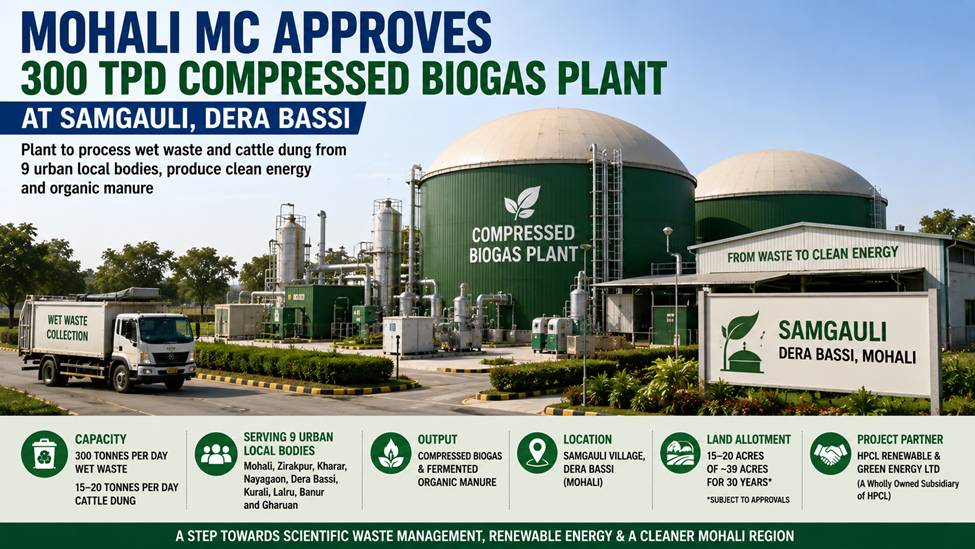
The Mohali Municipal Corporation has approved a proposal to establish a 300-tonne-per-day compressed biogas plant at Samgauli village in Dera Bassi, marking a significant step towards creating a regional system for processing wet municipal waste and converting it into useful energy and organic manure.
The project will be developed in partnership with HPCL Renewable & Green Energy Ltd (HPRGE), a wholly owned subsidiary of Hindustan Petroleum Corporation Ltd. The proposed facility is designed to process segregated organic waste collected from nine urban local bodies in and around the Mohali region.
The participating urban local bodies include Mohali, Zirakpur, Kharar, Nayagaon, Dera Bassi, Kurali, Lalru, Banur and Gharuan.
Under the proposal, around 300 tonnes of segregated wet waste could be supplied to the plant every day. In addition, the facility is expected to receive around 15 to 20 tonnes of cattle dung daily.
The organic material will be processed to produce compressed biogas along with fermented organic manure. This would allow biodegradable waste to be converted into useful products rather than being sent directly for conventional disposal.
The project is proposed to come up on land owned by the Mohali Municipal Corporation at Samgauli. The corporation has around 39 acres available at the location, of which approximately 15 to 20 acres may be allotted for the proposed facility.
The land is proposed to be provided to HPRGE for a period of 30 years, subject to the applicable terms, feasibility assessment and required approvals. The exact arrangements will be finalised through the formal agreements between the corporation and the company.
HPRGE will be responsible for carrying out the feasibility study, soil investigation and project planning. The company is also expected to bear the capital expenditure required for developing the facility and will undertake construction, installation of machinery and utilities, as well as subsequent operation and maintenance.
A major requirement for the success of the project will be a reliable supply of properly segregated wet waste. The participating municipal bodies will therefore have to ensure that organic waste is collected and transported separately to the facility.
The civic bodies will also have to support the project by facilitating road access and assisting with statutory clearances and the availability of basic utilities such as electricity and water.
The Municipal Corporation’s approval is an important step, but the project is not yet at the construction stage. The proposal will now move through land demarcation, feasibility assessment and other administrative formalities.
Further agreements are expected to include a memorandum of understanding, an arrangement for the regular supply of wet waste and a long-term land lease agreement between the Municipal Corporation and HPRGE.
The proposed facility is intended to provide a regional solution to the growing challenge of managing biodegradable municipal waste. Instead of treating wet waste simply as material for disposal, the project aims to recover value from it through the production of compressed biogas and organic manure.
The project also reflects the growing focus on alternative sources of clean energy. Compressed biogas can be used as a fuel, while the organic residue from the processing system can be utilised as manure, creating two useful outputs from biodegradable waste.
For the Mohali region, a centralised facility serving nine urban local bodies could help bring greater coordination to wet-waste management. It could also reduce the amount of organic material requiring conventional disposal if source segregation and transportation systems work effectively.
The proposal follows an earlier initiative by HPRGE to develop a municipal solid waste-based CBG facility in the region. The company had submitted an earlier proposal to the Punjab Municipal Infrastructure Development Company in 2024.
The latest approval provides a fresh opportunity to move the project forward, although its eventual implementation will depend on the completion of feasibility studies, agreements, statutory clearances and supporting infrastructure.
For residents of Mohali and surrounding towns, the project could become an important part of the region’s future waste-management system if implemented as planned.
The focus will now shift towards completing the remaining formalities and establishing the systems required to ensure a regular supply of segregated waste.
If successfully executed, the Samgauli CBG project could help the Mohali region move towards a more resource-oriented approach to waste management, where biodegradable waste is treated as a potential source of energy and organic material rather than simply as waste.

Mohali Dialogues
I work as a journalist and digital content writer for Mohali Dialogues, specializing in local news, civic issues, government updates, politics, education, business, and technology. I am committed to creating factual, well-researched, and engaging stories that help readers stay informed about the latest developments in Mohali, Punjab, and beyond.
Join the conversation
Keep it useful, respectful and relevant to the story.