Punjab:
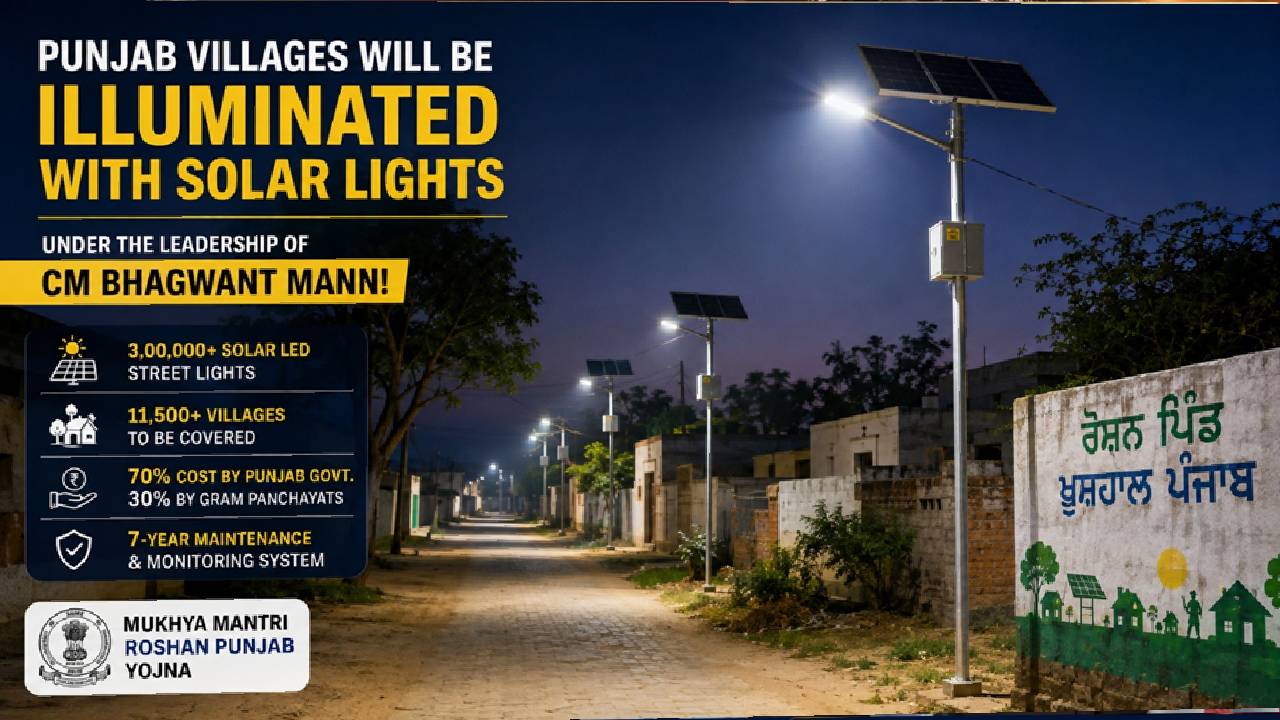
Thousands of villages across Punjab are set to receive a major upgrade in their street-lighting infrastructure as the state government rolls out its ambitious Mukhya Mantri Roshan Punjab Yojna, under which more than 3 lakh solar-powered LED streetlights are planned across rural areas.
The programme, approved by the Punjab Cabinet under the leadership of Chief Minister Bhagwant Mann, is aimed at improving lighting in villages while reducing dependence on conventional electricity. The initiative has been designed as a large-scale rural infrastructure and renewable-energy programme, with an estimated outlay of ₹550 crore.
The scheme covers around 11,500 villages, with implementation being carried out through the Punjab Energy Development Agency (PEDA). The installation programme is being rolled out in phases, with the government targeting completion of the major installation drive during 2026.
The decision to shift towards solar-powered streetlights is intended to address two issues at the same time — improving basic civic infrastructure in villages and encouraging the use of clean energy. Solar lights can operate independently of the conventional electricity grid, making them particularly suitable for rural locations where maintaining traditional street-lighting systems can be challenging.
Under the revised funding model, the Punjab Government will bear 70 per cent of the cost, while the remaining 30 per cent will be contributed by the respective Gram Panchayats. The arrangement is expected to reduce the financial burden on village bodies and make it easier for more Panchayats to participate in the programme.
The government has also introduced a technology-based monitoring mechanism for the new lighting network. Each installed light is planned to be geo-tagged, allowing its location to be recorded digitally. A centralised monitoring system will enable authorities to keep track of the functioning of lights and respond to complaints more efficiently.
Another important feature is the provision for long-term maintenance. The new installations will come with a seven-year maintenance arrangement, with provisions aimed at ensuring that faulty lights are repaired or replaced within a defined timeframe.
The programme is expected to have an impact beyond simply improving visibility on village streets. Better lighting can improve movement after dark, strengthen safety around public spaces and provide greater convenience for residents. Officials have particularly highlighted the potential benefits for women, children and elderly residents who may need to travel through village streets during evening hours.
The initiative also comes as Punjab is expanding its broader focus on renewable energy. Solar power is increasingly being used for public infrastructure, government buildings and rural facilities, with the state looking to reduce conventional power consumption and promote cleaner energy sources.
For villages, the availability of reliable street lighting can also support local economic activity. Better-lit streets and public areas can make it easier for shops and other small businesses to operate during evening hours, while improving access to community facilities.
The scheme follows concerns over the condition of older rural street-lighting infrastructure. Government officials have pointed out that a significant number of streetlights installed over previous decades are no longer functional. The new programme seeks to replace this ageing infrastructure with a standardised, solar-powered system supported by maintenance and digital monitoring.
The implementation model also gives Gram Panchayats a role in deciding their local requirements. This allows village-level bodies to identify areas where lighting is most needed and participate in planning the installation of lights according to local conditions.
For Punjab’s rural population, the programme represents a visible infrastructure change that can be seen directly on village streets. If implemented according to schedule and supported by effective maintenance, the solar lighting network could provide a more reliable system while keeping recurring electricity costs under control.
The government has positioned the initiative as part of its broader rural development agenda under Chief Minister Bhagwant Mann, with the objective of improving basic amenities while making greater use of renewable energy. As installation work progresses across the state, the success of the Mukhya Mantri Roshan Punjab Yojna will ultimately depend on timely execution, quality of equipment and regular maintenance. With more than 3 lakh solar streetlights planned, the programme has the potential to become one of Punjab’s largest rural renewable-energy infrastructure initiatives.

Mohali Dialogues
I work as a journalist and digital content writer for Mohali Dialogues, specializing in local news, civic issues, government updates, politics, education, business, and technology. I am committed to creating factual, well-researched, and engaging stories that help readers stay informed about the latest developments in Mohali, Punjab, and beyond.
Join the conversation
Keep it useful, respectful and relevant to the story.