Punjab:
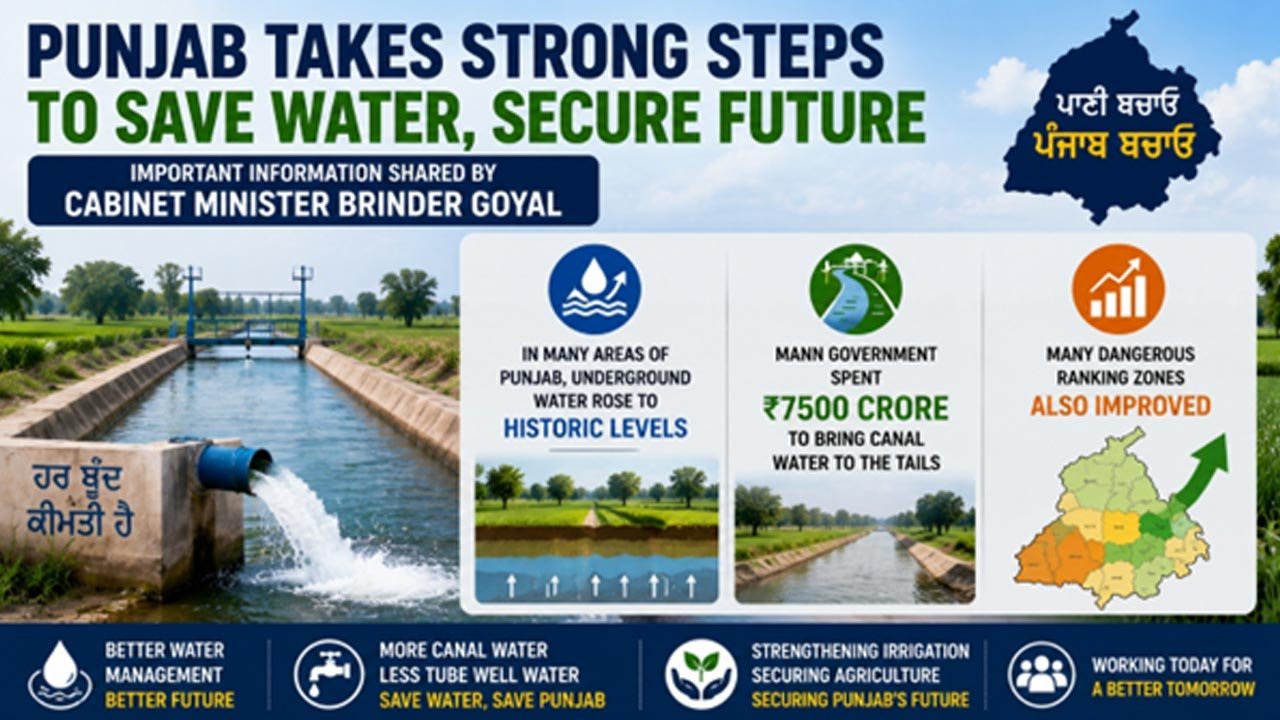
Punjab Water Resources Minister Brinder Kumar Goyal has highlighted the state government’s efforts to improve water management and reduce dependence on groundwater, saying that several areas of Punjab have recorded a significant improvement in groundwater levels.
During a press conference, Goyal outlined the steps taken by the Bhagwant Mann-led government to increase the use of canal water for agriculture and strengthen the state’s irrigation network.
According to the minister, the government has spent around Rs 7,500 crore on improving the utilisation of river water for irrigation and extending canal water to agricultural areas. The focus has been on strengthening existing canal infrastructure, restoring watercourses and ensuring that water reaches the tail ends of irrigation networks.
Goyal said the expansion of canal irrigation is an important part of the government’s strategy to reduce the pressure on groundwater. Punjab has historically relied heavily on tube wells for agriculture, particularly for paddy cultivation, which has contributed to the long-term decline of the state’s groundwater reserves.
The government has therefore been working to make canal water more accessible to farmers. The objective is to ensure that areas located at the tail ends of canal systems also receive adequate irrigation water instead of depending primarily on groundwater.
Recent irrigation projects have added thousands of acres to the area receiving canal water. In one such project in the Banga constituency, canal irrigation was extended to 4,890.91 acres across 55 villages, giving these agricultural areas access to canal water for the first time.
The project included the construction of pucca watercourses and underground pipelines designed to improve the distribution of canal water. Such infrastructure is important because even where canals carry sufficient water, inefficient distribution can prevent it from reaching farms located further away from the main channels.
Goyal has also pointed towards the restoration of older irrigation infrastructure. Several canals and watercourses that had remained damaged or non-functional for years have been restored as part of the government’s wider programme.
The minister has previously stated that thousands of kilometres of watercourses have been restored and that canal-water utilisation has increased substantially under the present government.
The focus on canal irrigation is closely linked to Punjab’s groundwater situation. Large parts of the state have faced groundwater stress for decades, with several agricultural blocks classified in critical or over-exploited categories.
The government is attempting to address the problem through a combination of canal expansion, groundwater recharge and improved water-use efficiency.
Recharge projects are another part of the strategy. Canal systems, ponds and other water-storage structures can help increase the amount of water entering the ground when properly designed and managed.
In several areas, new ponds and recharge structures are being connected with canals to facilitate groundwater replenishment. The government has also identified additional locations where recharge schemes can be developed.
Goyal has argued that increasing the availability of surface water can help farmers gradually reduce their dependence on tube wells. The long-term objective is to create a more balanced irrigation system in which canal water plays a larger role.
The minister also pointed to improvements in areas that were previously considered among the more stressed groundwater zones. While groundwater conditions vary considerably from one district and block to another, the government believes that increased canal-water availability and recharge measures can help improve the situation over time.
The issue is particularly important for Punjab because agriculture remains a major consumer of water. Any significant reduction in groundwater extraction will require changes not only in irrigation infrastructure but also in farming practices and crop patterns.
Canal irrigation alone cannot solve Punjab’s groundwater challenge. Efficient irrigation methods, crop diversification, rainwater conservation and responsible groundwater use will also be necessary to protect the state’s water resources in the long term.
The government has consequently been presenting the expansion of canal irrigation as part of a larger water-conservation strategy rather than simply an infrastructure programme.
For farmers, reliable canal water can provide an alternative source of irrigation and reduce the need to operate groundwater pumps. For the state, greater use of surface water could help slow the depletion of underground reserves.
The results of these measures will ultimately depend on how effectively canal networks are maintained, how fairly water is distributed and whether groundwater extraction continues to decline in areas facing the greatest stress.
Punjab’s water challenge remains significant, but the government’s latest figures and irrigation projects indicate an effort to shift the state’s water management approach towards greater use of surface water and stronger groundwater conservation.
The message from the Water Resources Department is that protecting Punjab’s groundwater will require sustained investment and long-term planning. Ensuring that canal water reaches farmers, particularly those at the tail ends of irrigation systems, remains a key part of that effort. As more irrigation projects are completed and additional recharge measures are introduced, the government hopes to strengthen Punjab’s water security while reducing the dependence of agriculture on rapidly declining groundwater reserves.

Mohali Dialogues
I work as a journalist and digital content writer for Mohali Dialogues, specializing in local news, civic issues, government updates, politics, education, business, and technology. I am committed to creating factual, well-researched, and engaging stories that help readers stay informed about the latest developments in Mohali, Punjab, and beyond.



Join the conversation
Keep it useful, respectful and relevant to the story.