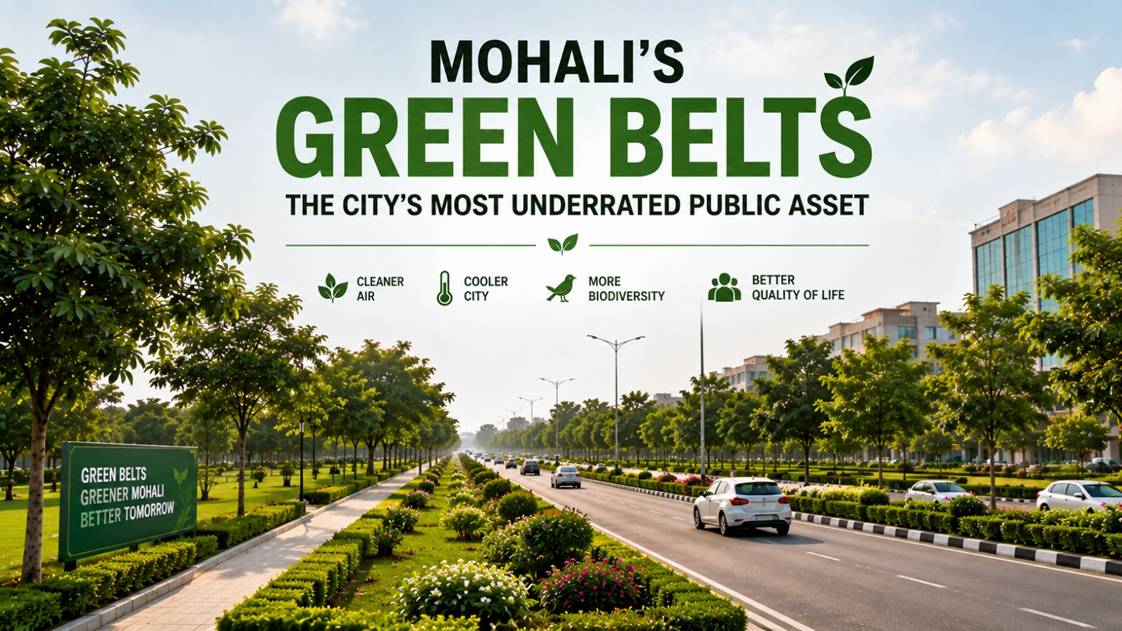
When people think about the infrastructure that shapes a city, roads, bridges, public transport and buildings often come to mind. Rarely do green belts receive the same attention. Yet across Mohali, these stretches of landscaped greenery quietly perform a role that is just as important. Running alongside major roads, separating traffic corridors from residential areas and connecting different parts of the city, green belts have become one of Mohali’s most valuable—and most overlooked—public assets.
Unlike parks, which are designed as destinations, green belts are woven into the everyday fabric of urban life. Residents pass them while commuting to work, walking through their neighbourhoods or travelling across the city. Because they are so common, their contribution is often taken for granted. Yet without them, Mohali would feel significantly different—hotter, dustier and far less visually appealing.
One of the defining characteristics of Mohali’s urban landscape is its extensive network of green corridors. Along Airport Road, sector-dividing roads, major boulevards and developing townships, rows of trees, shrubs, flowering plants and landscaped medians create a continuous presence of greenery throughout the city. These spaces soften the impact of urban development and help maintain a balance between built infrastructure and the natural environment.
The environmental benefits of green belts are substantial. Trees and plants act as natural air filters, helping absorb pollutants while trapping dust particles generated by traffic and construction activity. In a rapidly growing city, this role becomes increasingly important. Green belts also contribute to reducing the urban heat effect by providing shade and lowering surface temperatures, making surrounding areas more comfortable during Punjab’s intense summers.
Beyond their environmental value, green belts play a significant role in shaping the visual identity of the city. Well-maintained stretches of greenery create attractive streetscapes that enhance the overall experience of travelling through Mohali. Whether it is a visitor entering the city for the first time or a resident making a daily commute, these green corridors contribute to a sense of order, cleanliness and civic pride.
Many of Mohali’s most recognizable roads derive part of their character from the landscaping that surrounds them. Wide avenues lined with trees and flowering plants create a more welcoming urban environment than concrete corridors dominated solely by vehicles and infrastructure. These visual improvements may seem subtle, but they have a lasting impact on how people perceive and experience a city.
Green belts also serve important ecological functions. They provide habitats for birds, butterflies and other forms of urban wildlife that continue to thrive despite increasing urbanisation. Even relatively narrow strips of vegetation can contribute to biodiversity by creating interconnected green corridors across the city.
For pedestrians and cyclists, green belts offer additional benefits. Tree-lined roads provide shade, improve comfort and encourage outdoor activity. As cities around the world seek to create more walkable and people-friendly environments, green infrastructure has become an essential component of urban planning. Mohali’s network of green belts already provides a strong foundation for this approach.
The value of these spaces becomes even more apparent when comparing cities that lack similar green infrastructure. Roads without vegetation often experience higher temperatures, greater dust levels and a harsher urban environment. In contrast, Mohali’s green corridors help create a more balanced and livable atmosphere despite rapid development and increasing traffic volumes.
As newer areas such as Aerocity, IT City and other expanding sectors continue to develop, green belts remain a critical part of long-term planning. Integrating greenery into urban infrastructure ensures that growth does not come at the expense of environmental quality. Instead, it allows development and sustainability to progress together.
Maintaining these green assets requires ongoing effort. Plantation, irrigation, landscaping and regular upkeep are essential to preserving the health and appearance of green belts. Their value may not always be immediately visible in economic terms, but their contribution to environmental quality, public well-being and urban aesthetics is undeniable.
Today, Mohali’s green belts represent far more than decorative landscaping. They are environmental infrastructure, public spaces and ecological assets all rolled into one. Quietly running through the city, they help improve air quality, support biodiversity, reduce heat and create a more attractive urban environment.
In many ways, these green corridors embody an important lesson about city building. The success of a city is not measured solely by what is constructed, but also by what is preserved. Mohali’s green belts may not always make headlines, but they continue to play a vital role in shaping a cleaner, healthier and more livable city for everyone.

Mohali Dialogues
I work as a journalist and digital content writer for Mohali Dialogues, specializing in local news, civic issues, government updates, politics, education, business, and technology. I am committed to creating factual, well-researched, and engaging stories that help readers stay informed about the latest developments in Mohali, Punjab, and beyond.
Join the conversation
Keep it useful, respectful and relevant to the story.