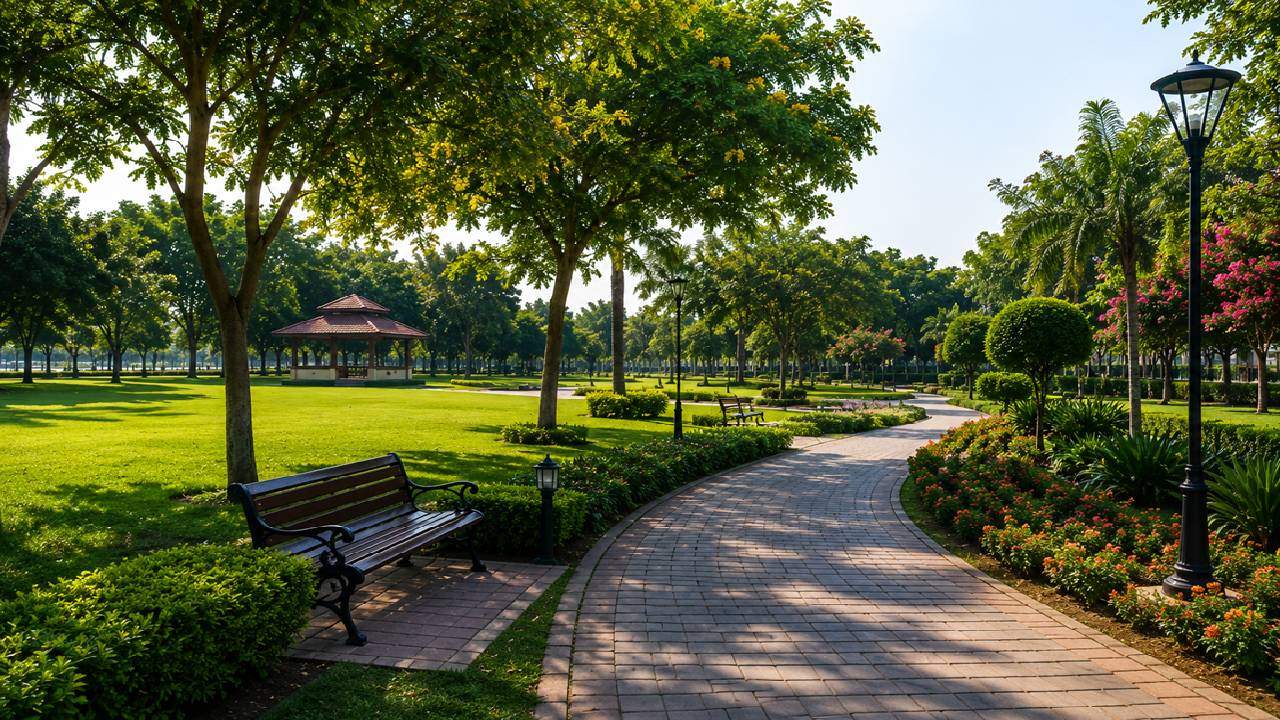
There was a time when large parts of Mohali felt functional, but visually incomplete.
The city was expanding rapidly, yet many public spaces lacked the greenery, lighting and urban character expected from a modern metropolitan centre. Several roundabouts remained plain, road medians appeared neglected and newly developing sectors often looked more under construction than fully shaped urban spaces.
That visual experience, however, has started changing noticeably after 2022.
Today, landscaped corridors, illuminated roads, decorative roundabouts and greener public stretches are becoming increasingly visible across Mohali. From Airport Road and Aerocity to newer sector belts and public parks, the city’s changing appearance reflects a broader push toward urban beautification and liveability.
One of the most noticeable transformations can be seen along the Airport Road corridor.
Once viewed primarily as a transit route connecting Chandigarh to the international airport, the corridor is now gradually evolving into one of Mohali’s most visually organised urban stretches. Over the last few years, multiple sections across Airport Road have witnessed:
- redesigned medians,
- decorative plantation,
- modern street lighting,
- cleaner landscaping,
- and upgraded public presentation.
Compared to earlier years, the corridor today projects a far more modern urban character.
The change is not limited to Airport Road alone.
Across sectors connected to:
- Aerocity,
- IT City,
- Sector 79–80,
- PR-road corridors,
- and southern Mohali belts,
public spaces increasingly reflect greater attention toward aesthetics and visual planning.
Roundabouts that once functioned merely as traffic points are now gradually being redesigned with:
- themed landscaping,
- decorative lighting,
- organised plantation,
- modern signage,
- and cleaner maintenance standards.
This shift has significantly altered the visual rhythm of several major intersections across the city.
The expansion of green corridors is another visible change after 2022.
Several newly developing stretches now feature:
- wider landscaped medians,
- organised tree plantation,
- greener road edges,
- and improved visual continuity across public roads.
As Mohali continues expanding geographically, these green corridors are increasingly shaping the city’s identity as a more modern and liveable urban centre.
Public parks have also witnessed gradual improvements across multiple sectors.
Walking tracks, lighting systems, seating zones and landscaped green spaces have become more visible in several residential pockets, contributing to stronger community activity and improved public experience.
Even Mohali’s night-time appearance has changed considerably over the last few years.
Improved LED lighting across major roads and public spaces has made several corridors feel brighter, more active and more organised after sunset. Areas that once appeared relatively dull during evening hours now remain visibly illuminated and commercially active late into the night.
This transformation has contributed not only to aesthetics, but also to the broader perception of safety, cleanliness and urban confidence across the city.
Perhaps the biggest difference today is that Mohali increasingly feels designed not just for expansion, but for experience.
Earlier, many public spaces across the city appeared temporary or transitional despite rapid growth around them.
Today, the focus increasingly appears to be shifting toward how the city looks, feels and presents itself to residents and visitors alike.
From landscaped roundabouts and greener corridors to illuminated roads and cleaner public spaces, Mohali’s beautification push is steadily reshaping the city’s visual identity.
The city is no longer growing only in size. It is beginning to grow in character

Mohali Dialogues
I work as a journalist and digital content writer for Mohali Dialogues, specializing in local news, civic issues, government updates, politics, education, business, and technology. I am committed to creating factual, well-researched, and engaging stories that help readers stay informed about the latest developments in Mohali, Punjab, and beyond.
Join the conversation
Keep it useful, respectful and relevant to the story.