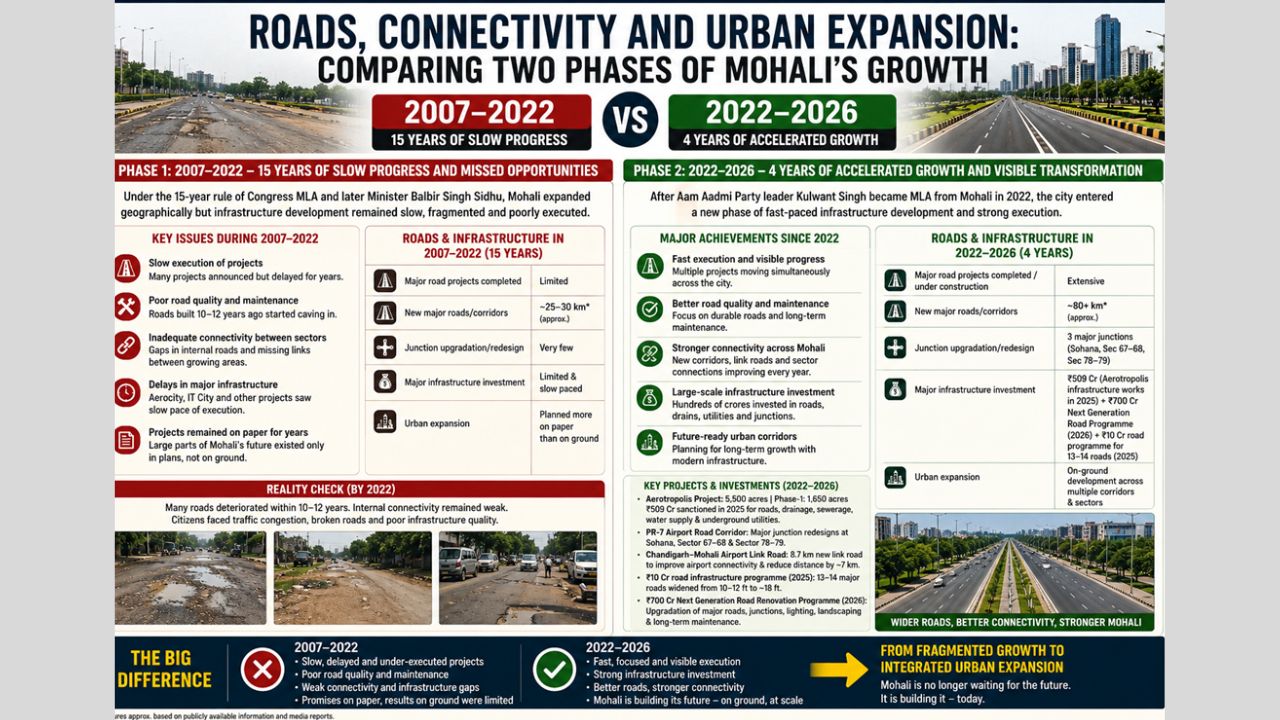
For nearly 15 years between 2007 and 2022, Mohali remained under the political leadership of Congress MLA and later Punjab cabinet minister Balbir Singh Sidhu. During this period, the city continued to expand geographically, but the pace of visible infrastructure development often struggled to match Mohali’s growing urban ambitions.
Despite Mohali being positioned next to Chandigarh and home to Punjab’s international airport corridor, several major infrastructure projects moved slowly, connectivity gaps persisted and large parts of the city’s future expansion remained confined to announcements and planning documents for years.
Road conditions across multiple sectors deteriorated steadily, internal connectivity between emerging urban pockets remained uneven and several newly developing areas lacked the scale of infrastructure expected from Punjab’s most rapidly urbanising city.
By 2022, Mohali had undoubtedly grown — but much of that growth still appeared fragmented rather than fully integrated.
The contrast after 2022, however, has become increasingly visible across the city.
After Aam Aadmi Party leader Kulwant Singh became MLA from Mohali in 2022, infrastructure activity across roads, urban corridors and connectivity projects began accelerating at a noticeably different pace. Over the last four years, Mohali has witnessed simultaneous road expansion, junction redesigns, urban corridor strengthening and large-scale infrastructure investment across multiple parts of the city.
Today, the difference can be experienced directly while moving through Mohali itself.
One of the clearest examples is the transformation of the PR-7 Airport Road corridor, which has increasingly emerged as the backbone of modern Mohali. Major redesign plans were initiated for key junctions including:
- Sohana Junction
- Sector 67–68 Junction
- Sector 78–79 Junction
These redesigns were aimed at improving traffic movement, reducing congestion and modernising Mohali’s most important urban corridor.
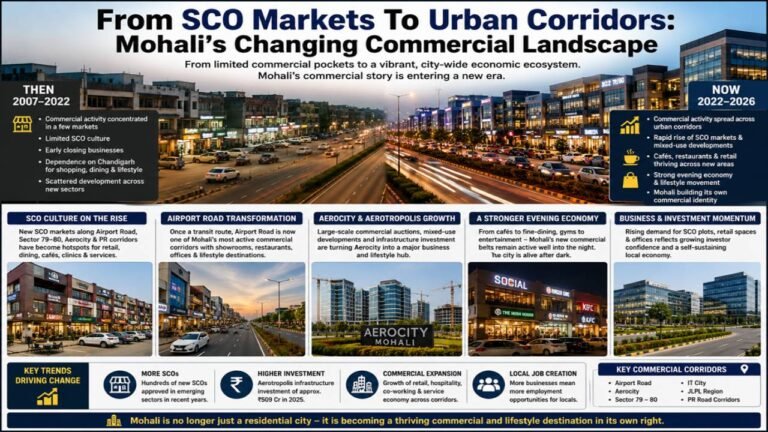
At the same time, the scale of development surrounding Aerocity and Aerotropolis accelerated sharply after 2022.
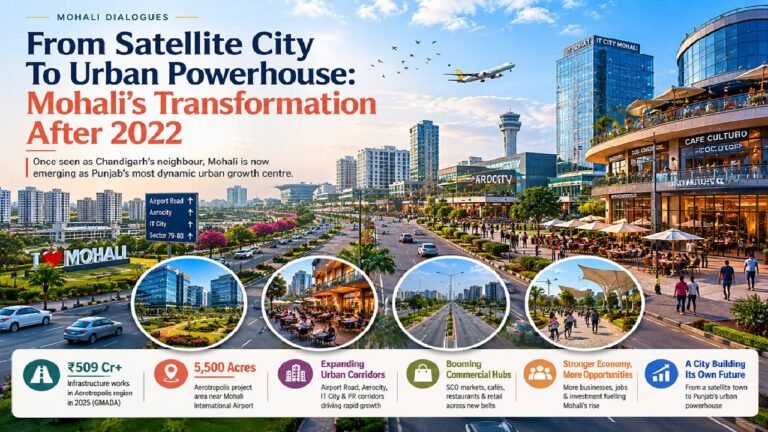
According to GMADA, the Aerotropolis project spans nearly 5,500 acres near the international airport. In 2025 alone, infrastructure works worth approximately ₹509 crore were sanctioned for:
- road infrastructure,
- underground utilities,
- drainage systems,
- sewerage networks,
- water supply systems,
- and integrated urban development.
The project represents one of the largest ongoing urban infrastructure pushes in the region.
Another major difference after 2022 has been the visible spread of road development beyond Mohali’s traditional sectors.
Road expansion and strengthening works increasingly focused on:
- Airport Road,
- Landran Road,
- Kharar-Banur Road,
- Sector 82–Manauli corridor,
- PR-7 growth belt,
- and southern Mohali villages.
- In 2025, a dedicated ₹10 crore road infrastructure programme was launched covering nearly 13–14 major roads across Mohali constituency. Several stretches were widened from nearly 10–12 feet to almost 18 feet to support increasing traffic and future urban growth.
- Compared to the earlier phase between 2007 and 2022, Mohali today feels far more interconnected.
- Construction activity is now spread across multiple growth corridors simultaneously:
- Aerocity,
- IT City,
- Airport Road belt,
- PR roads,
- Sector 113 onwards,
- and expanding southern sectors of Greater Mohali.
- The city’s roads appear wider.
- Urban corridors are busier.
- Commercial movement is stronger.
- And infrastructure activity is no longer limited only to older sectors close to Chandigarh.
- The pace of execution itself has also changed significantly.
- In early 2026, Punjab announced a ₹700 crore “Next Generation Road Renovation Programme” for Mohali focused on:
- major road upgrades,
- redesigned junctions,
- modern street lighting,
- landscaping,
- carriageway expansion,
- and long-term road strengthening.
- This is among the largest recent road modernisation programmes undertaken in the city.
- Perhaps the biggest contrast between the two periods lies not only in infrastructure spending, but in infrastructure visibility itself.
- Between 2007 and 2022, Mohali’s future often felt planned more on paper than visible on the ground.
- Since 2022, that future increasingly feels physically under construction across the city itself.
- Today, a drive through Airport Road, Aerocity or the expanding PR corridors no longer gives the impression of a city waiting to grow. Instead, Mohali now appears like a city actively moving into its next urban phase

Mohali Dialogues
I work as a journalist and digital content writer for Mohali Dialogues, specializing in local news, civic issues, government updates, politics, education, business, and technology. I am committed to creating factual, well-researched, and engaging stories that help readers stay informed about the latest developments in Mohali, Punjab, and beyond.
Join the conversation
Keep it useful, respectful and relevant to the story.