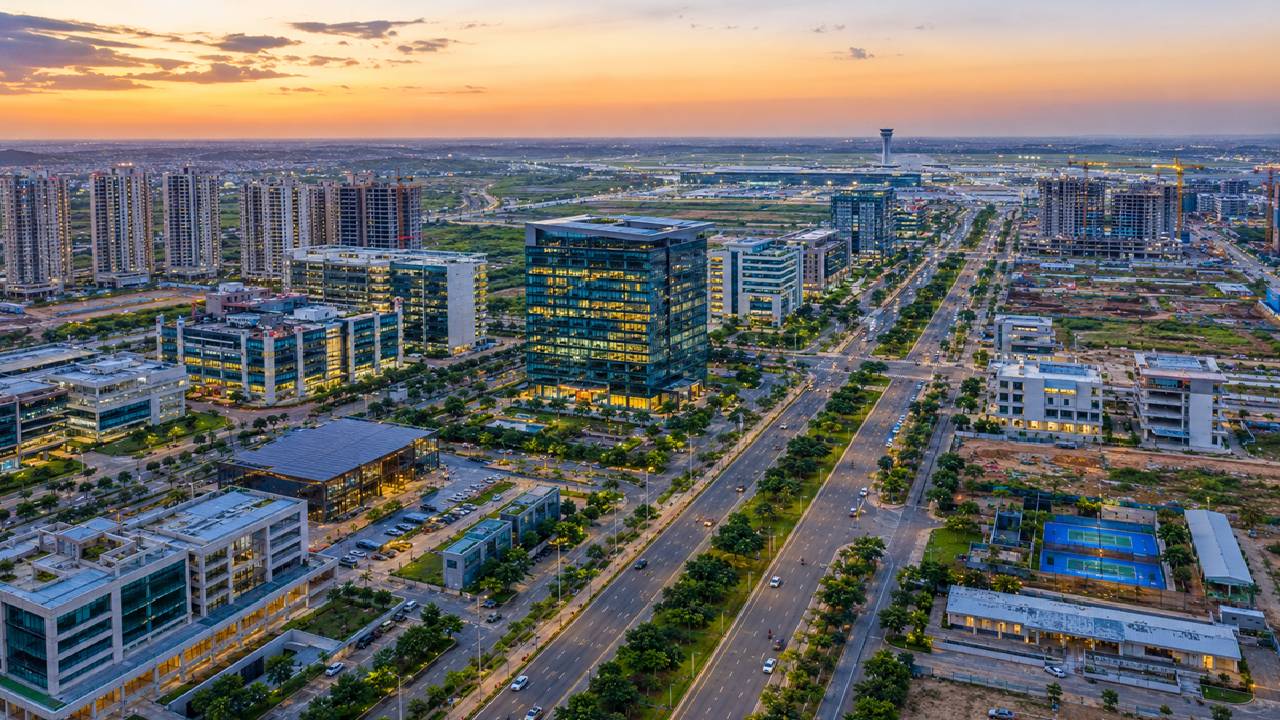
For years, Mohali’s urban growth remained concentrated around its older phases and Chandigarh-facing sectors.
While the city steadily expanded between 2007 and 2022, large parts of southern Mohali still appeared transitional — with vast open land pockets, scattered construction activity and long-term projects developing at a relatively gradual pace.
Several newly planned sectors existed more on maps and future plans than as fully active urban zones.
That landscape, however, has changed dramatically over the last few years.
Today, the stretch from Aerocity to IT City represents one of the fastest transforming urban corridors in North India — combining:
- residential expansion,
- commercial investment,
- infrastructure growth,
- healthcare institutions,
- IT development,
- and modern urban planning
into a rapidly evolving metropolitan landscape.
One of the biggest visible transformations has taken place around the Airport Road corridor.
Earlier viewed largely as a transit route connecting Chandigarh to the international airport, the corridor has now emerged as Mohali’s defining urban spine. Wide roads, landscaped medians, commercial SCO belts and rapidly expanding residential sectors have significantly altered the visual and economic character of the region.
The rise of Aerocity has played a major role in this transformation.
Planned by GMADA near Chandigarh International Airport, Aerocity has gradually evolved from a proposed township into one of Punjab’s most active urban development zones.
Today, the area features:
- large residential clusters,
- commercial markets,
- hospitality projects,
- educational institutions,
- healthcare facilities,
- and expanding retail infrastructure.
Compared to earlier years, the pace of visible development across Aerocity has accelerated sharply after 2022.
Infrastructure works across the Aerotropolis region have further strengthened this expansion.
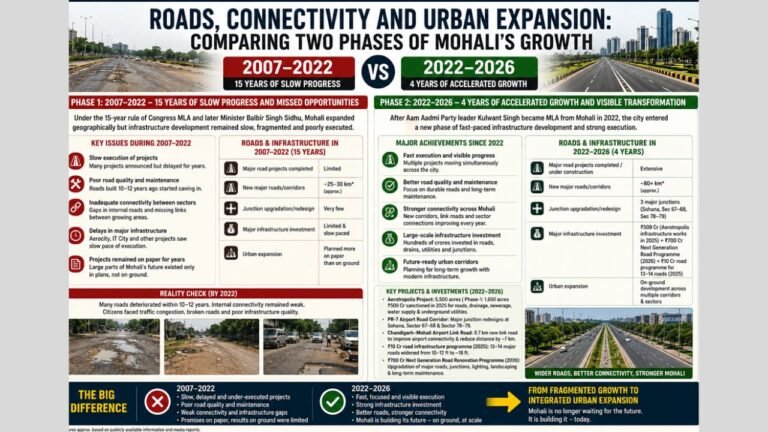
According to GMADA, the larger Aerotropolis project spans nearly 5,500 acres around the airport belt. In 2025 alone, infrastructure projects worth approximately ₹509 crore were initiated across the region covering:
- roads,
- drainage systems,
- underground utilities,
- sewerage networks,
- water supply,
- and integrated urban infrastructure.
This large-scale investment is steadily transforming southern Mohali into a major long-term urban and economic growth zone.
The emergence of IT City has added another important layer to Mohali’s changing landscape.
Once viewed primarily as a future technology project, the region today increasingly reflects a broader shift toward:
- digital businesses,
- office infrastructure,
- startup activity,
- professional employment,
- and modern commercial development.
The growing presence of IT-related infrastructure has contributed significantly to the rise of Mohali’s young professional workforce and expanding white-collar economy.
At the same time, new urban sectors across:
- PR-road corridors,
- Sector 113 onwards,
- Airport Road belts,
- and Greater Mohali
continue witnessing rapid residential and commercial growth.
Construction activity today appears far more geographically spread than it did a few years ago. Instead of development remaining concentrated around older phases, multiple urban corridors are now expanding simultaneously across the city.
This transformation is also changing how people perceive Mohali itself.
Earlier, large parts of the city still carried the image of a developing suburban extension beside Chandigarh.
Today, Mohali increasingly appears as a modern urban region building its own large-scale metropolitan identity.
The city’s changing skyline reflects this shift clearly.
Glass-front commercial buildings, modern residential societies, wide urban boulevards and integrated commercial corridors are becoming increasingly common across newer sectors.
The expansion of:
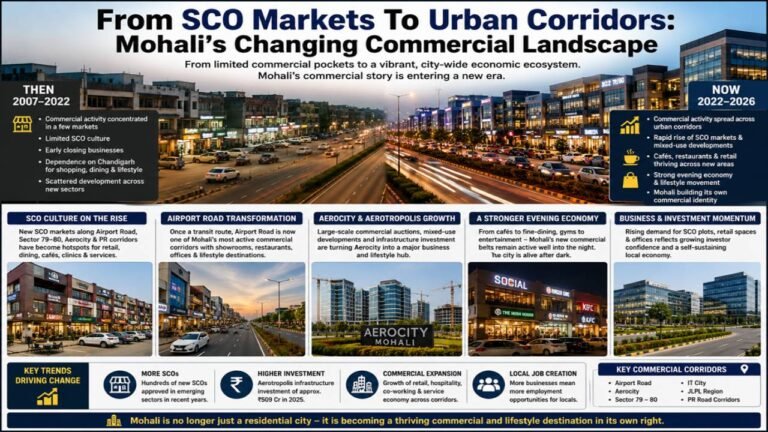
- cafés,
- retail markets,
- fitness centres,
- co-working spaces,
- and hospitality infrastructure
has further accelerated the growth of these emerging urban zones.
Perhaps the biggest difference today is scale.
Earlier, development across southern Mohali often felt fragmented and future-oriented.
Today, much of that future is becoming physically visible.
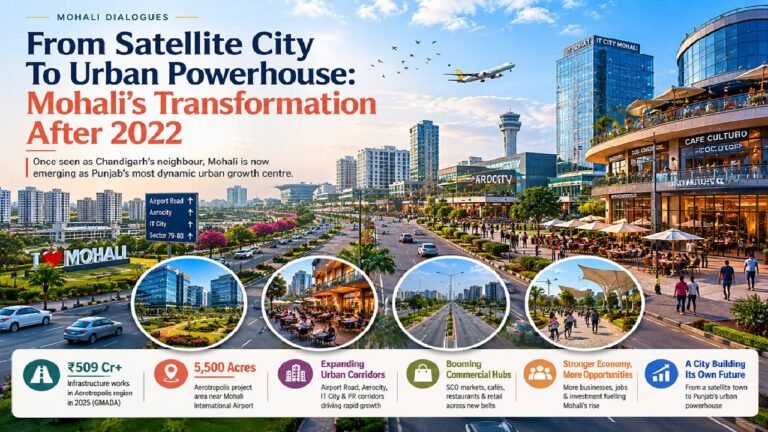
From Aerocity and IT City to expanding airport corridors and new residential sectors, Mohali’s urban landscape is evolving at a pace that is steadily reshaping the region’s economic and metropolitan identity.
The city is no longer expanding only outward.
It is expanding upward, outward and economically all at once.

Mohali Dialogues
I work as a journalist and digital content writer for Mohali Dialogues, specializing in local news, civic issues, government updates, politics, education, business, and technology. I am committed to creating factual, well-researched, and engaging stories that help readers stay informed about the latest developments in Mohali, Punjab, and beyond.
Join the conversation
Keep it useful, respectful and relevant to the story.