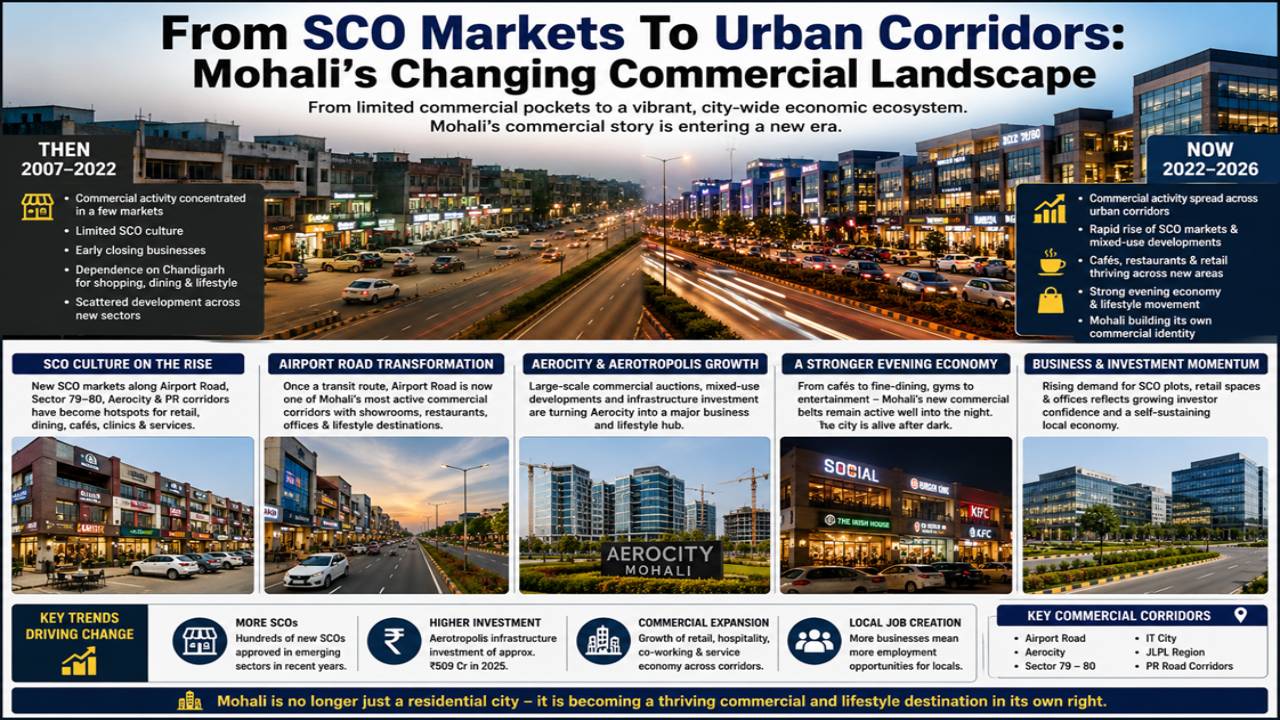
For years, Mohali’s commercial activity remained concentrated around a few established markets and Chandigarh-facing sectors. Areas like Phase 7, Phase 3B2 and select inner-sector markets formed the city’s primary commercial centres, while much of Mohali’s newer expansion zones remained largely residential or under development.
Despite Mohali’s rapid geographical growth between 2007 and 2022, its commercial ecosystem often struggled to keep pace with the city’s urban ambitions.
Several newly developed sectors lacked vibrant market activity, large stretches of Airport Road remained commercially underutilised and many residents continued depending heavily on Chandigarh for shopping, dining and lifestyle experiences.
While commercial projects certainly emerged during this period, the pace of visible economic activity often appeared scattered rather than integrated across the city.
The years after 2022, however, have brought a noticeably different commercial rhythm to Mohali.
Today, commercial activity is no longer limited to traditional inner markets. Instead, Mohali’s economic energy is increasingly spread across:
- Airport Road,
- Aerocity,
- IT City,
- PR corridors,
- Sector 82 onwards,
- and newly developing mixed-use urban belts.
One of the biggest transformations has been the rise of SCO culture across Mohali’s expanding sectors.
Over the last few years, newly developed SCO markets along Airport Road and Aerocity have witnessed rapid growth in:
- cafés,
- restaurants,
- retail showrooms,
- fitness centres,
- clinics,
- co-working spaces,
- and lifestyle businesses.
Unlike the older phase of Mohali’s commercial expansion, newer developments now appear designed around integrated urban movement rather than isolated sector markets.
This shift is particularly visible across the Airport Road belt.
A corridor that once functioned largely as a transit route toward the international airport is now steadily evolving into one of Mohali’s most commercially active urban stretches. Evening movement across Airport Road today reflects a level of economic activity rarely associated with the area a few years ago.
The rise of Aerocity has played a major role in this transformation.
According to GMADA, Aerocity and Aerotropolis together represent one of Punjab’s largest planned urban-commercial expansion zones near the international airport. Commercial auctions, mixed-use developments and infrastructure expansion across these sectors have accelerated significantly in recent years.
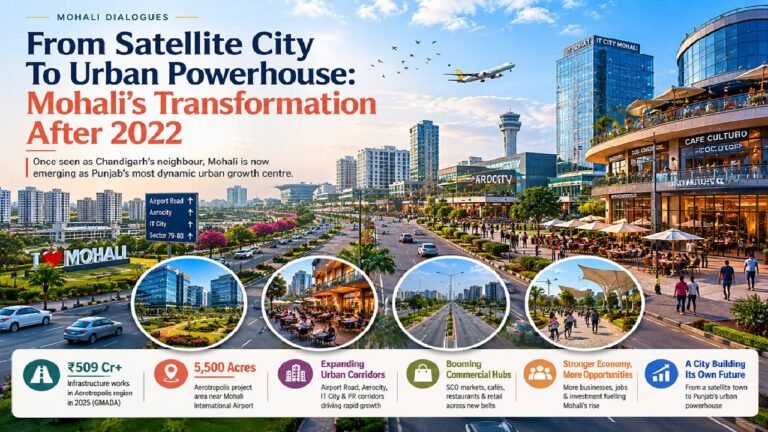
In 2025, GMADA continued major infrastructure works worth nearly ₹509 crore across the Aerotropolis region, including roads, drainage systems, utility infrastructure and urban corridor development aimed at supporting long-term commercial and residential growth.
This expanding infrastructure network has directly contributed to rising commercial movement across southern Mohali.
Another major difference after 2022 has been the increasing visibility of Mohali’s evening economy.
Earlier, commercial movement across several parts of the city slowed significantly after business hours, with residents often travelling toward Chandigarh for dining and entertainment.
Today, newer commercial belts across:
- Airport Road,
- Sector 79,
- Sector 80,
- Aerocity,
- JLPL region,
- and PR-road corridors
remain active late into the evening, reflecting changing consumer patterns and growing urban confidence within Mohali itself.
Commercial real estate movement has also intensified.
Demand for SCO plots, retail spaces and mixed-use commercial properties across emerging corridors has increased steadily as Mohali’s urban footprint expands beyond its traditional sectors.
Large-scale residential growth in Aerocity, IT City and adjoining sectors has further accelerated local commercial demand, reducing the city’s earlier dependence on Chandigarh-centric markets.
Compared to the 2007–2022 phase, Mohali today feels commercially more distributed, more active and far more self-sustaining.
The city no longer revolves around a handful of established markets alone.
Instead, multiple urban corridors are simultaneously emerging as centres of retail activity, food culture, office movement and lifestyle-oriented commerce.
Perhaps the biggest change is not only economic — but psychological.
For years, Mohali was often viewed as an extension of Chandigarh’s economy.
Today, the city increasingly appears to be developing its own commercial identity.
From expanding SCO belts and growing café culture to integrated urban corridors and rising business activity, Mohali’s commercial landscape is no longer growing quietly in the background.
It is becoming one of the clearest visible signs of the city’s changing urban character.

Mohali Dialogues
I work as a journalist and digital content writer for Mohali Dialogues, specializing in local news, civic issues, government updates, politics, education, business, and technology. I am committed to creating factual, well-researched, and engaging stories that help readers stay informed about the latest developments in Mohali, Punjab, and beyond.
Join the conversation
Keep it useful, respectful and relevant to the story.