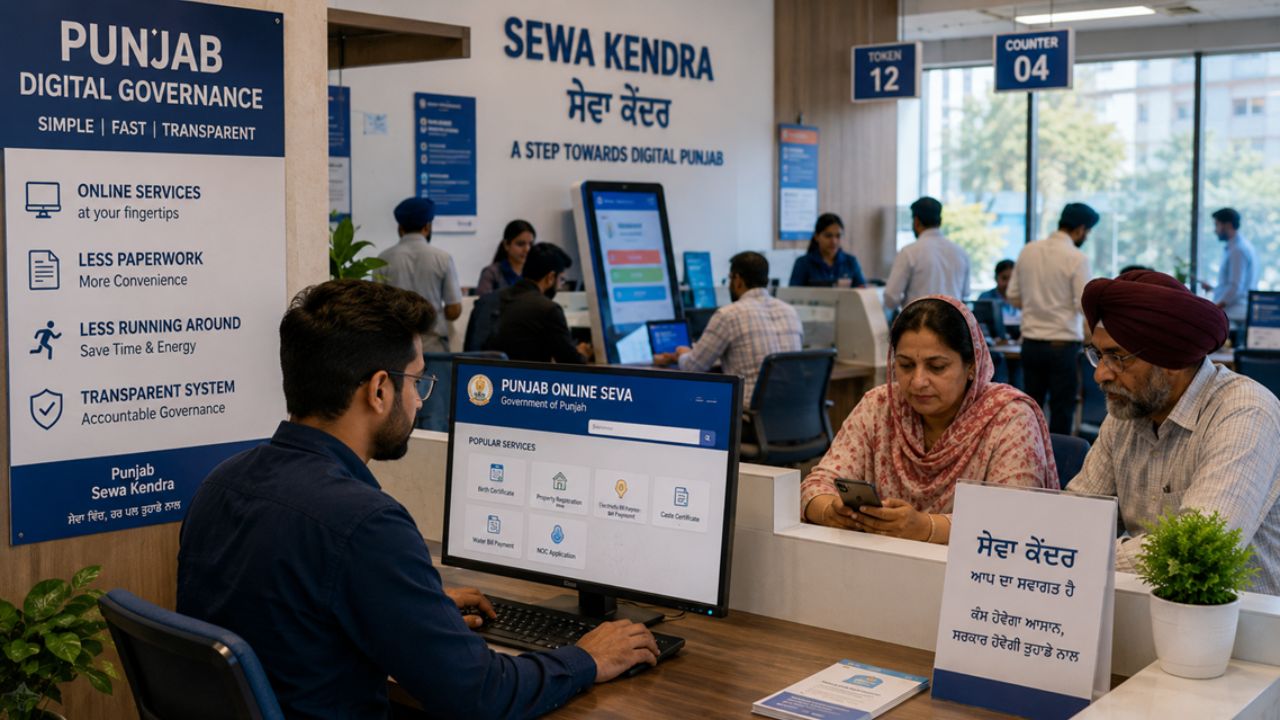
For decades, government-related work in Punjab often meant long queues, repeated office visits and endless paperwork. From certificates and registrations to basic civic documentation, ordinary citizens regularly described the system as exhausting, slow and heavily dependent on middlemen.
In Mohali today, many residents say that experience is gradually changing.
Across Sewa Kendras and digital service centres, citizens are increasingly using online systems for routine government work that earlier required multiple physical visits. Property-related documentation, certificates, utility services and various approvals are becoming more accessible through digital processes, reducing both time and uncertainty for ordinary families.
Under the leadership of Bhagwant Mann, the Punjab Government has repeatedly emphasised digital governance and administrative transparency as major priorities. The idea, officials say, is to reduce bureaucratic friction and make everyday governance more citizen-friendly.
In urban constituencies like Mohali, residents say the impact is becoming visible in practical ways.
Working professionals especially describe digital services as a major convenience. Earlier, taking leave from work for government-related paperwork was considered normal. Now, many services can be initiated online or completed through streamlined processes that require far fewer visits than before.
For senior citizens too, easier access to documentation and online systems has reduced dependency on agents and intermediaries. Families say even basic improvements in administrative efficiency make a meaningful difference in day-to-day life.
Residents often connect this governance shift with Mohali’s broader development-focused political atmosphere under Kulwant Singh. As the city modernises physically through roads and infrastructure, citizens say governance systems are also slowly adapting to a more urban and technology-driven environment.
The changing expectations of Mohali’s population are also pushing this transition forward. Younger residents increasingly expect government services to function with the same speed and convenience they experience in banking, shopping or digital payments. In many ways, Mohali’s growing urban identity is creating demand for a more responsive governance culture.
Small business owners say digital systems have helped reduce delays in several routine procedures. Students applying for documents or certifications describe the process as more manageable than earlier experiences shared by previous generations.
Importantly, many residents say the biggest improvement is not just technological — it is psychological. When systems become simpler and more transparent, people feel less intimidated by governance itself.
That change matters in a state where public frustration with bureaucracy remained common for many years.
Of course, challenges still exist. Technical delays, digital literacy gaps and uneven implementation continue to affect some services. Citizens also believe further reforms will be necessary to ensure consistency across departments and regions.
But despite these concerns, many Mohali residents say Punjab’s gradual digital shift represents meaningful progress.
Because for ordinary people, governance is often judged not through speeches or policies alone — but through the ease of everyday life.
And increasingly, many citizens believe that everyday experience is becoming smoother.

Mohali Dialogues
I work as a journalist and digital content writer for Mohali Dialogues, specializing in local news, civic issues, government updates, politics, education, business, and technology. I am committed to creating factual, well-researched, and engaging stories that help readers stay informed about the latest developments in Mohali, Punjab, and beyond.
Join the conversation
Keep it useful, respectful and relevant to the story.