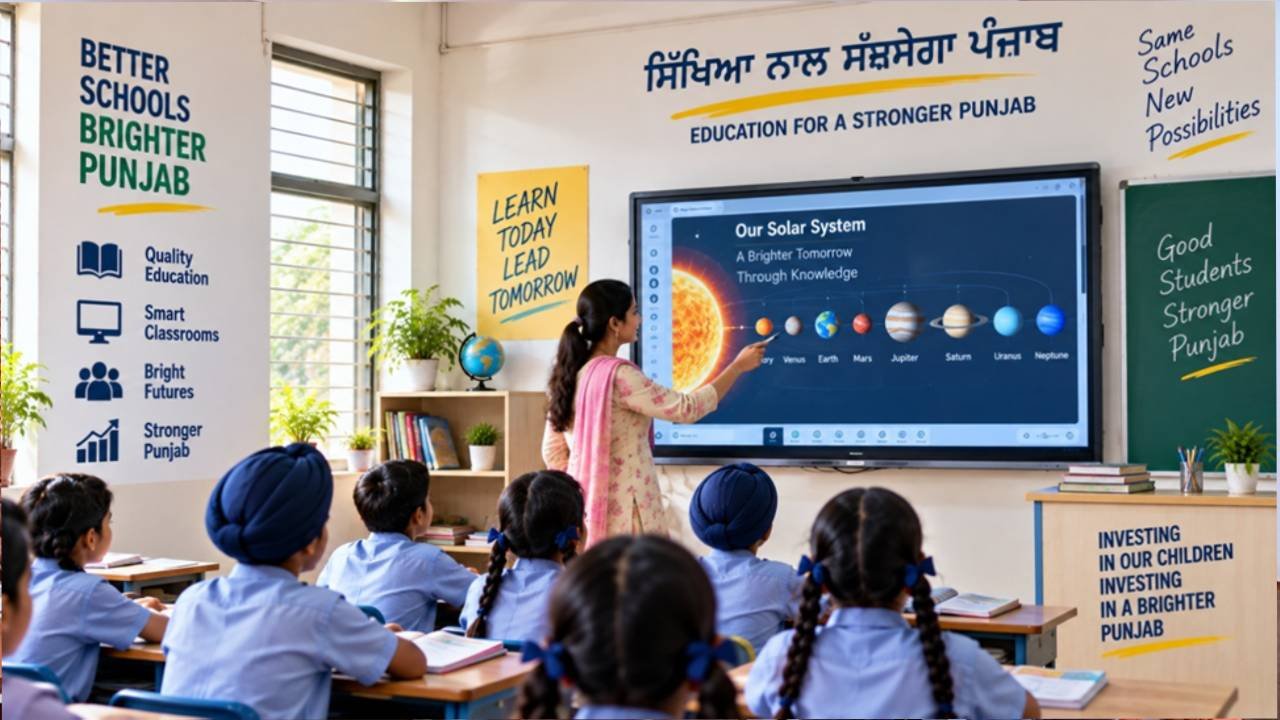
Punjab News: Government schools in Punjab have undergone significant changes in recent years, with the state government focusing on infrastructure, technology, attendance monitoring and improvements in the classroom environment.
The Bhagwant Mann government has described these initiatives as part of its wider education revolution, aimed at making government schools more modern and improving the overall learning experience for students.
One of the recent changes is the introduction of a real-time student attendance tracking system. Under the system, parents receive daily SMS alerts about their child’s attendance and absence from school. The system is also designed to help education authorities monitor attendance more closely and identify students who may be missing classes regularly.
According to the state government, prolonged absence will trigger further follow-up. A child remaining absent for seven days is to be followed up at the district level, while cases involving more than 15 days of absence are to be flagged to the state level.
Technology has also become a larger part of classroom learning in government schools. Smart classrooms, interactive panels, computer facilities and improved digital infrastructure are being introduced across the state.
The government announced a ₹400-crore digitalisation programme earlier this year under Punjab Sikhya Kranti. The programme includes the establishment of dedicated computer labs in thousands of government schools and the replacement of outdated computer equipment with newer digital learning facilities.
The state’s 2026-27 budget documents also provide for thousands of smart classrooms and ICT facilities in government schools, along with additional classrooms and modern infrastructure.
Punjab has also expanded its focus on specialised schools and improved learning facilities. The state government has highlighted the development of Schools of Eminence and other infrastructure projects as part of its effort to provide students with better academic opportunities within the government school system.
The changes are not limited to technology. School infrastructure has also received attention, including classrooms, toilets, furniture, drinking-water facilities, boundary walls and other basic amenities.
In August, Punjab Education Minister Harjot Singh Bains said around ₹2,300 crore had been spent on school infrastructure since the Mann government came to power. He also claimed that around 3.6 lakh students had moved from private schools to government schools since 2022.
The government has also been emphasising teacher training and professional development. Punjab has sent teachers for training programmes outside the state and abroad, while the administration has linked teacher development with improvements in classroom learning.
At the same time, parent participation has become another focus area. Parent-teacher meetings and attendance-related communication are being used to create closer coordination between schools and families.
The government’s education push has also included a stronger focus on learning outcomes. Chief Minister Bhagwant Mann recently said Punjab had moved from a low position in national education rankings to the top position in primary education, while outlining his vision of making Punjab a global education hub.
For students, the most visible difference is increasingly being seen inside the classroom itself. Digital teaching tools, improved furniture, better school facilities and closer attendance monitoring are changing how government schools operate.
While the scale and impact of these reforms will continue to be assessed through learning outcomes and independent evaluations, the government’s focus has clearly shifted towards combining infrastructure development with technology, attendance monitoring and teacher training. For Punjab’s government-school students, the objective is to create an environment where better facilities and modern teaching methods can support stronger learning and prepare them for future academic and career opportunities.

Mohali Dialogues
I work as a journalist and digital content writer for Mohali Dialogues, specializing in local news, civic issues, government updates, politics, education, business, and technology. I am committed to creating factual, well-researched, and engaging stories that help readers stay informed about the latest developments in Mohali, Punjab, and beyond.

Join the conversation
Keep it useful, respectful and relevant to the story.