Punjab:
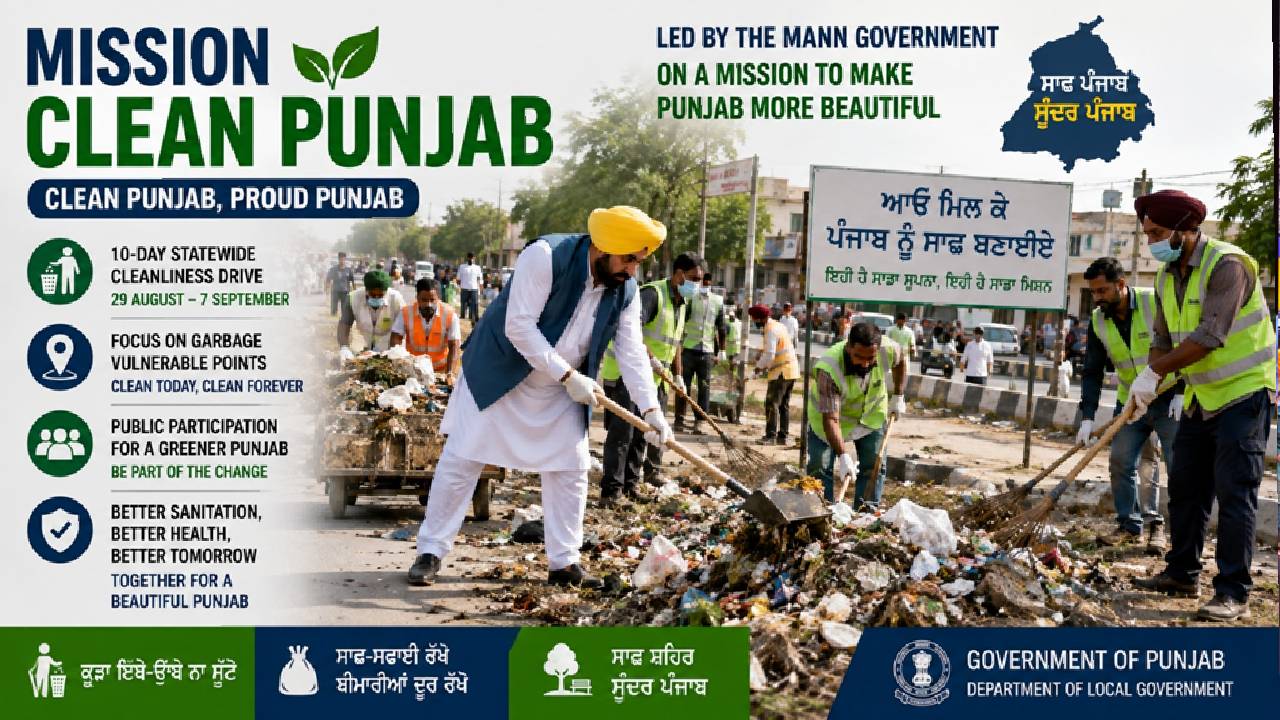
The Punjab Government has stepped up its cleanliness campaign with the launch of Mission Clean Punjab, a 10-day statewide drive aimed at removing garbage from vulnerable locations and improving sanitation across cities and towns.
The special campaign began on August 29 and will continue until September 7. Under the initiative, Cabinet Ministers, MLAs, mayors, municipal councillors and senior officials are taking part in cleanliness activities and supervising sanitation work on the ground.
The campaign is being conducted under the broader vision of “Clean Punjab, Proud Punjab”, with a particular focus on Garbage Vulnerable Points (GVPs) — locations where waste is repeatedly dumped and accumulates over time.
Rather than treating cleanliness as a one-time exercise, the government has emphasised the need to identify the reasons behind recurring garbage accumulation and take measures to prevent the same spots from becoming dumping points again.
Local Government Minister Harjot Singh Bains has been leading the statewide campaign, with ministers and officials participating directly in cleanliness activities in different parts of Punjab.
The campaign also encourages residents to become part of the effort. Public participation is considered important because maintaining clean streets and public spaces cannot depend entirely on municipal workers. Residents can play a role by avoiding open dumping, using designated waste-collection systems and reporting locations where garbage is repeatedly being dumped.
The government’s approach also places emphasis on field-level monitoring. Senior officers and civic officials have been directed to remain actively involved in sanitation arrangements rather than relying only on reports from municipal staff.
The latest drive builds on the cleanliness programme launched earlier this year, when the Punjab Government introduced Mission Clean Punjab with a stronger focus on technology-based monitoring, regular field inspections and accountability among urban local bodies.
During the current 10-day campaign, special teams are being deployed to clear identified garbage-prone locations. The objective is not simply to remove accumulated waste but also to improve the condition of the surrounding area and prevent the garbage from returning.
The campaign has also brought health and environmental concerns into focus. Accumulated waste can attract insects and animals, create unpleasant surroundings and contribute to sanitation problems. Removing such waste and improving local cleanliness can therefore have benefits beyond the appearance of streets and public areas.
In Patiala, Health Minister Dr Balbir Singh led a cleanliness activity as part of the campaign and called for cleanliness to become part of everyday civic behaviour. Similar activities are being conducted in towns and cities across the state.
The initiative is also intended to improve the appearance of Punjab’s urban areas. Cleaner roads, markets, public spaces and neighbourhoods can contribute to a better environment for residents as well as visitors.
For municipal bodies, however, the bigger challenge will be maintaining the improvements after the 10-day campaign ends. Regular waste collection, effective segregation, enforcement against illegal dumping and adequate sanitation infrastructure will be necessary to ensure that cleaned locations do not once again become dumping points.
The campaign therefore combines immediate cleaning work with a longer-term objective of improving municipal sanitation practices.
Mohali and other cities in the state are also expected to benefit from the drive as local civic authorities identify vulnerable locations and intensify cleaning operations.
The government’s decision to involve elected representatives and senior officials directly is intended to increase accountability at the local level. Their participation also sends a message that cleanliness is being treated as a civic priority rather than solely as the responsibility of sanitation workers.
The success of Mission Clean Punjab will ultimately depend on what happens after the waste is removed. If municipal systems are able to maintain regular collection, ensure proper disposal and discourage repeated dumping, the campaign could lead to lasting improvements.
For residents, the campaign provides an opportunity to contribute to that effort by keeping public spaces clean and supporting responsible waste-management practices.
With the 10-day drive continuing through September 7, Punjab is now focused on clearing garbage-vulnerable locations and creating cleaner surroundings across its cities and towns. Mission Clean Punjab is therefore being presented not merely as a cleanliness campaign, but as a broader effort to build cleaner public spaces, strengthen civic responsibility and make Punjab healthier and more attractive for its residents.

Mohali Dialogues
I work as a journalist and digital content writer for Mohali Dialogues, specializing in local news, civic issues, government updates, politics, education, business, and technology. I am committed to creating factual, well-researched, and engaging stories that help readers stay informed about the latest developments in Mohali, Punjab, and beyond.
Join the conversation
Keep it useful, respectful and relevant to the story.